
Wirt County Criminal Court Cases
Wirt County criminal court cases split between two local courts. The Magistrate Court hears misdemeanors, receives criminal complaints, sets bail, and conducts preliminary examinations when a felony is charged. It also handles affidavits and arrest or search warrants. A felony may begin there, but the magistrate docket is not the whole prosecution. The prosecuting attorney may take evidence to a grand jury, after which an indictment moves the matter into Circuit Court.
The Circuit Court is West Virginia's general-jurisdiction trial court of record. In Wirt County it hears all felonies, certain misdemeanors, and appeals from magistrate or municipal court. The Circuit Clerk keeps the pleadings, docket entries, orders, exhibits, and judgments. These records answer a different question than a booking file. A booking confirms custody at a point in time; the court file traces what charge was filed and how the court resolved it.
The state Judiciary's Wirt County court directory identifies the local offices and court roles. That directory is the best first check when a portal result does not make clear which clerk has the document.
| Court | Criminal role | Local contact |
|---|---|---|
| Wirt County Magistrate Court | Misdemeanors, complaints, bail, warrants, and felony preliminary examinations | 90 Market Street, Elizabeth; 304-275-3642 |
| Wirt County Circuit Court | Felonies, certain misdemeanors, and lower-court appeals | 19 Court Street, Elizabeth; 304-275-6597 |
Which Wirt County Court Has It
The charge level and case stage point to the right Wirt County court. A misdemeanor that stayed in Magistrate Court should have its complaint, bond record, hearing entries, disposition, and any warrant return at the Magistrate Clerk's office. A felony complaint also starts in that court. Once a grand jury indictment is filed, later pleas, motions, trial entries, judgment, and sentence belong in the Circuit Court file. An appeal from Magistrate Court creates a circuit record as well.
This division can trip up a searcher who finds the early Wirt County case number and assumes it covers the final result. Keep that magistrate number when contacting the Circuit Clerk. It can help staff connect the initial proceeding with a later circuit prosecution. Judge's chambers and the clerk's counter are not interchangeable either. The judge decides matters in the case; the clerk acts as record custodian and handles public copy requests.
Note: A filed charge is an allegation, and only the final judgment or signed disposition establishes how that charge ended.
Searching Wirt County Case Records
Use the free Magistrate Record Search for misdemeanor files and early felony proceedings. The Judiciary says it accepts a first name, last name, or case number and returns no more than 30 records. It supplies case information, not document images. For circuit matters, open WVPASS. Public users may register and download available circuit documents for a nominal fee, though the public landing material does not state the amount.
- Start with Magistrate Record Search when the court level is unknown or the matter may be a misdemeanor.
- Pass the human-verification gate, then search by a name or known case number.
- Record the Wirt County label and case number from a possible match. Do not treat an empty or capped result list as final.
- Search WVPASS for a felony, circuit appeal, or later circuit filing, and review the docket and any public documents.
- Ask the correct Wirt County clerk for the complaint, order, judgment, sentence, or certified copy needed.
The official Magistrate Record Search information page explains both the search limits and the need for clerk validation.
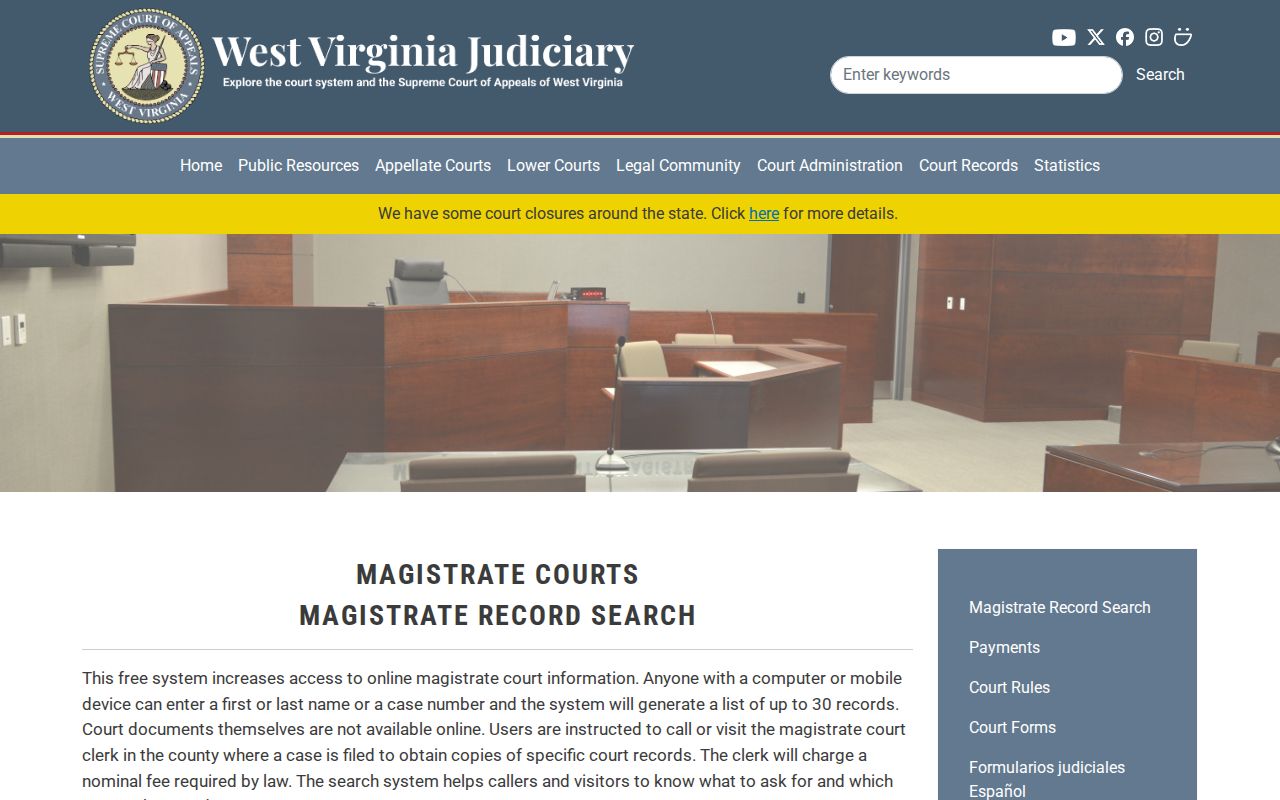
The image reinforces a key Wirt County search rule: use the online index to discover a case, then obtain the actual filing from the clerk.
| Field or control | Type | Required | Format note |
|---|---|---|---|
| Click to continue | Checkbox or CAPTCHA gate | Yes, to proceed | Human-verification entry control |
| Submit | Button | Not stated | Advances from the gate |
| First Name | Text | Unspecified | May be used for a name search |
| Last Name | Text | Unspecified | May be used for a name search |
| Case Number | Text | Unspecified | Alternative when the identifier is known |
Wirt County Clerk Counter Routes
The Magistrate Clerk is the local route for a specific complaint, docket, bond order, disposition, or warrant return that does not appear as a document online. The office is at 90 Market Street in Elizabeth, and the clerk's number is 304-275-3642. Give the case number when possible. If the file is old or not imaged, ask whether staff can check the paper docket and whether the public may inspect it at the office.
For Wirt County Circuit Court material, contact Circuit Clerk Carol Frame at 19 Court Street, P.O. Box 465, Elizabeth, WV 26143, by phone at 304-275-6597 or by email at carold.frame@courtswv.gov. A plain or certified circuit paper should be identified by its exact title and case number. Under W. Va. Code §59-1-11(a)(2), a transcript, copy, or paper made by the circuit clerk for use outside the office costs $1 per page. Ask about certification and postage before sending payment because those amounts are not established in the Wirt research.
Wirt County Circuit Clerk
19 Court Street, P.O. Box 465
Elizabeth, WV 26143
304-275-6597
carold.frame@courtswv.gov
Wirt County Magistrate Clerk
90 Market Street
Elizabeth, WV 26143
304-275-3642
Inside a Wirt County Case File
A Wirt County case file is a sequence, not one summary page. The charging paper shows what the state alleged. Docket entries show what was filed and when the court acted. A plea, trial result, dismissal order, or judgment explains the outcome. The sentence and any later probation or revocation order describe what followed. Reading only the first charge can miss an amended count, dismissal, acquittal, or later order.
The public view of the West Virginia Judiciary's court systems shows how circuit access is separated from the magistrate index.
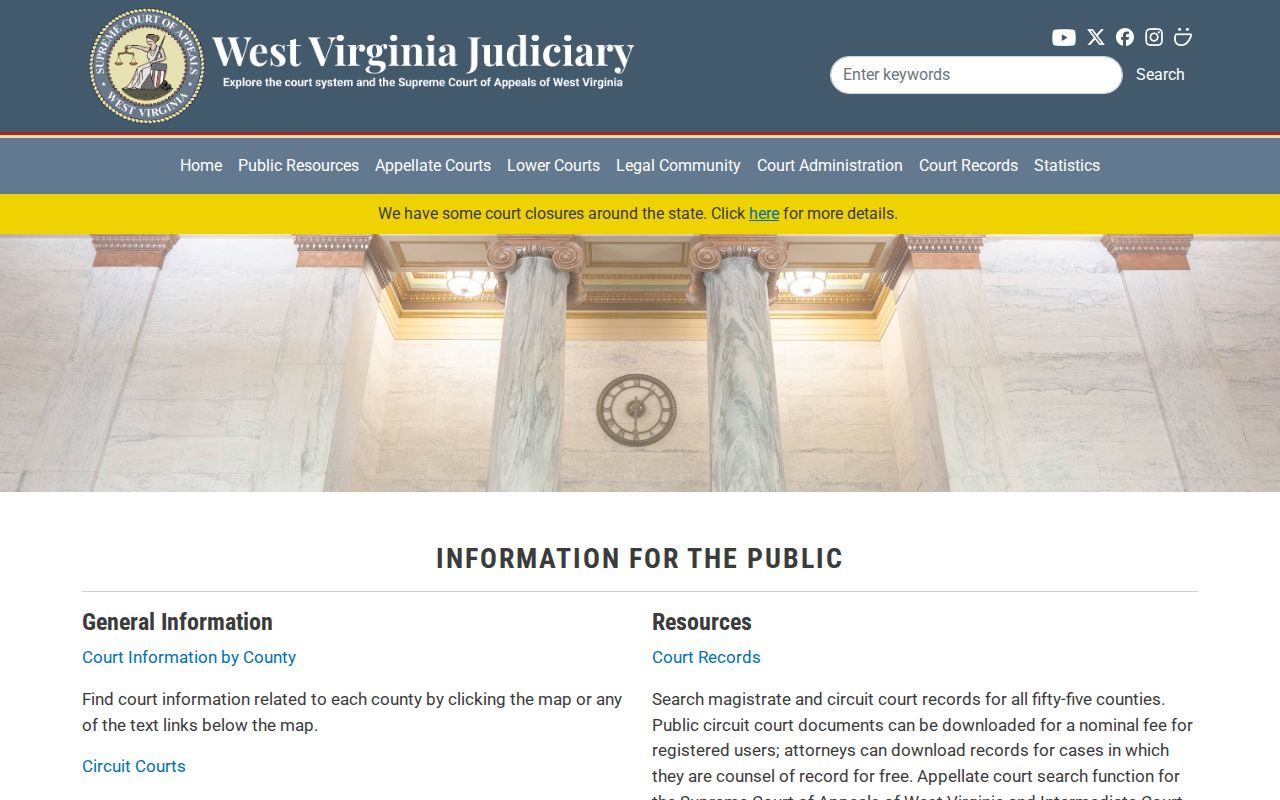
For Wirt County, that statewide access layer leads back to the local clerk whenever the signed paper is absent or certification is required.
| Case Number and Court | Identifies the docket and whether the file belongs to Magistrate or Circuit Court. |
|---|---|
| Charging Document | States the alleged offense in a complaint or indictment; it is not a finding of guilt. |
| Docket Entries | Chronicle filings, hearings, motions, pleas, and orders in date order. |
| Hearing Dates | Show scheduled and completed court events, including arraignment and pretrial proceedings. |
| Disposition and Judgment | Records whether a charge led to conviction, dismissal, acquittal, or another result. |
| Sentence and Conditions | States the court's penalty and may include later probation or revocation entries. |
Reading Wirt County Case Outcomes
Case status words need context. A pending Wirt County charge has no final outcome yet. A dismissal ends that charge without a conviction. An acquittal means the judge or jury did not find guilt beyond a reasonable doubt. A guilty plea becomes a conviction once the court accepts it and enters judgment. A warrant entry may mark a failure to appear or an unserved charging warrant, but the warrant itself does not prove guilt.
Compare the docket with the signed final order. Online summaries can lag or omit the document that controls. If a state criminal-history record later shows a wrong or missing disposition, first obtain the correct court order from the originating Wirt County clerk. The West Virginia State Police Criminal Identification Bureau challenge process then uses that source record to address a repository mismatch. This is also why a court search and a fingerprint-based personal record review should not be described as the same product.
- Arraignment
- The hearing where the charge is stated and a plea is entered.
- Disposition
- The way a charge ends, such as conviction, dismissal, or acquittal.
- Indictment
- A grand jury's formal felony charging document filed in Circuit Court.
- Pending
- A status showing that the Wirt County case has not reached a final result.
Note: A custody search may help locate someone, but it cannot replace the Wirt County judgment that states the case outcome.
How a Criminal Case Moves
A Wirt County criminal case commonly begins with an arrest or complaint and an initial magistrate appearance. The court may address identity, counsel, charges, and bail. For a felony, Magistrate Court conducts the early proceedings and may hold a preliminary examination. The prosecuting attorney can present the matter to the grand jury. An indictment places the felony prosecution in Circuit Court, where arraignment, motions, discovery, a plea or trial, judgment, and sentence follow. A misdemeanor can remain with the magistrate through plea or trial and judgment, with an appeal available to Circuit Court.
Case flow: Charges Filed › Arraignment › Pretrial › Plea or Trial › Disposition › Sentencing
Each step can create a new docket entry or paper. A searcher who needs proof should ask for the document tied to the needed stage, not a vague request for every criminal record. That keeps the Wirt County request precise and helps the clerk locate the right file.
Wirt County Drug Court Path
The Mid-Ohio Valley Adult Drug Court has served Wirt, Doddridge, Pleasants, Ritchie, and Wood Counties since 2007. It is a regional treatment-court path, not a separate public case-search portal. Official participation material says adult treatment courts may serve a person charged with, pleading guilty to, or found guilty of a drug-related offense or another offense in which substance use was a factor.
Eligibility is not automatic. State law excludes specified cases, including certain felony crimes of violence and registry-triggering offenses, subject to the program rules described by the Judiciary. Prosecutors and treatment-court judges have final participation authority. For a Wirt County file, program activity should be read with the underlying court docket and orders. The normal Magistrate Court or Circuit Court custodian still holds the public case record, subject to lawful limits.
Case Record Access & Restrictions
The West Virginia Freedom of Information Act permits inspection or copying of nonexempt public records and requires a request to describe the material with reasonable specificity. The custodian must produce it, arrange inspection, or issue a written denial as soon as practicable and within five days, excluding weekends and legal holidays. Actual reproduction cost may be charged, but the statute bars a search, retrieval, or employee-time fee. Court access can also be governed by judiciary rules and the circuit clerk fee law.
Public access has firm boundaries. W. Va. Code §29B-1-4 protects specified private, investigative, and security material. Juvenile files have their own confidentiality rules. An expungement can remove a qualifying case from public inspection and public court websites while preserving narrow lawful access. Redaction or a missing portal result does not mean the underlying event never existed.
When Wirt County Documents Are Missing
The exact Magistrate Record Search form begins with a human-verification gate before its name and case-number fields.
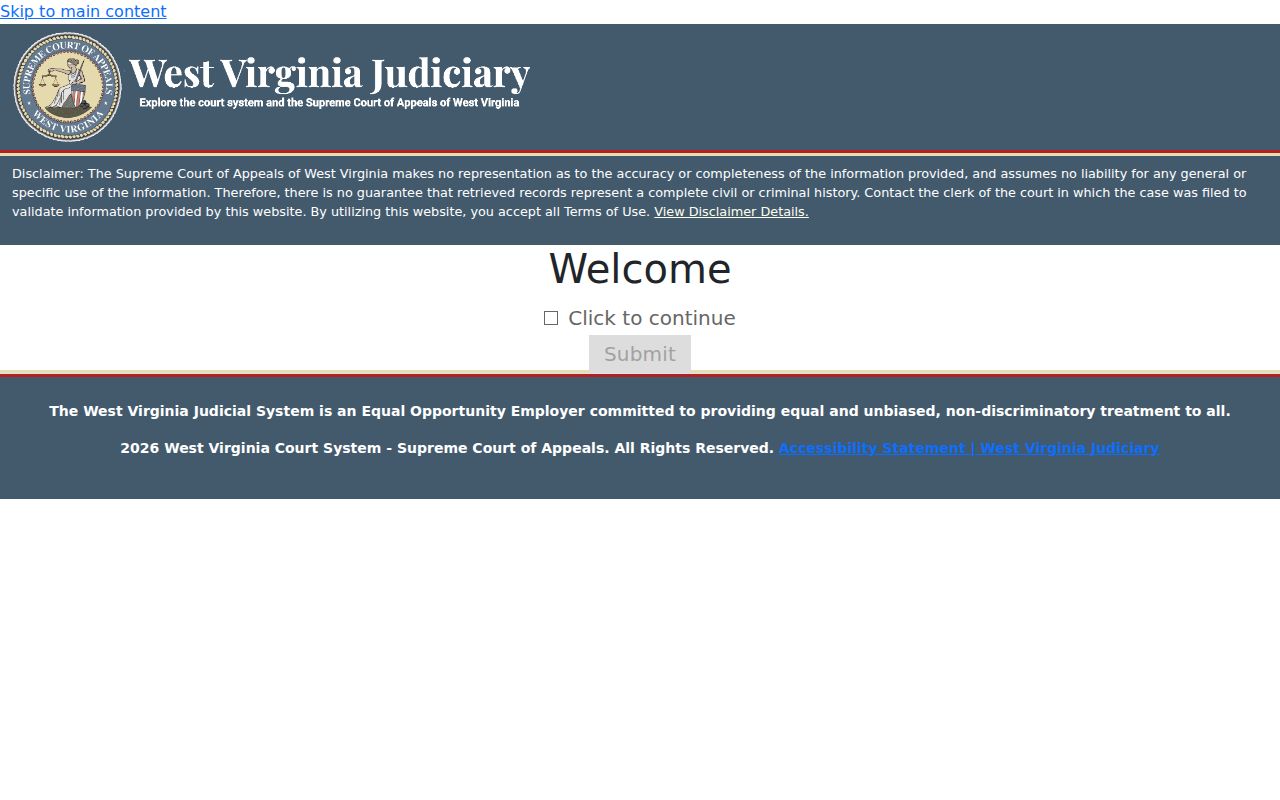
The gate, the 30-result limit, and the lack of document images make the Wirt County clerk fallback an essential part of the search rather than an optional extra.
If a case does not appear, try spelling variations and any known number, then check the other court level. Call the Magistrate Clerk for misdemeanor or preliminary felony material and the Circuit Clerk for felony, appeal, archived, or non-imaged papers. Ask whether the physical docket can be searched and whether inspection is available. When the issue is an old arrest rather than a filed case, the broader Wirt County criminal history overview explains why the arresting agency and court may hold different parts of the record.
Note: No portal result is proof of no Wirt County case because limits, archives, spelling, restrictions, and reporting delays can hide a match.